Category: accounting industry trends

  • AI for Accounting in 2026: How Accounting Firms Turn Automation Into Advisory Advantage

    AI for Accounting in 2026: How Accounting Firms Turn Automation Into Advisory Advantage

    AI for accounting practices has passed the experiment stage, it is operational.

    By 2025, 88% of organizations report regular AI usage in at least one business function (McKinsey, 2025). In the UK alone, 98% of accounting practices already use AI in daily workflows, reporting average time savings of nearly 19 hours per week (Sach, 2025).

    On paper, this looks like success.

    However, in practice many firms still struggle to translate those gains into better advice, stronger client relationships, or higher-value services.

    This gap explains why AI adoption has not automatically produced advisory transformation and why AI for accounting now needs a second layer: structured interpretation.

    That layer is where Claryx.ai operates.

    What “AI for Accounting” Actually Means Today

    In simpler terms, AI for accounting refers to capabilities embedded across modern AI accounting software and cloud accounting applications, including:

    • Automated transaction classification and reconciliation
    • Continuous variance and anomaly detection
    • Pattern recognition across large financial datasets
    • AI-assisted summaries and forecasts

    These tools are effective at speed and scale.

    However, research shows that most firms apply AI in isolated workflows rather than end-to-end decision processes. Adoption is wide, but maturity is uneven.

    In other words:

    Firms have AI but not a system for turning AI output into consistent insight.

    The Productivity Paradox in AI for Accounting: Why Advisory Still Bottlenecks

    Firms using AI report completing tasks in 31% less time on average, primarily through accounting automation applications that reduce manual effort (Xero, 2025).

    Yet those gains often stall at reporting.

    Why?

    Because AI produces:

    • More alerts
    • More dashboards
    • More summaries

    But not more clarity.

    This creates a paradox where accountants spend less time preparing data but more time deciding:

    • Which insights matter
    • How to explain them
    • Whether they justify client action

    Without structure, AI for accounting increases signal volume without improving decision quality.

    Why AI Accounting Software Statistics Don’t Create Advisory Insight

    AI excels at identifying what changed. It struggles with why it matters.

    This is not a technology failure it’s a category misunderstanding.

    According to industry research, AI systems:

    • Cannot determine materiality without business context
    • Cannot judge which anomalies are decision-relevant
    • Cannot own accountability for recommendations

    This is why professional judgment remains central to accounting, even as automation accelerates.

    AI supports accountants, it does not replace their reasoning.

    The Missing Advisory Layer in AI for Accounting Software

    Most AI accounting software stops at analysis. Claryx.ai starts where most tools stop.

    Claryx.ai is designed as an advisory layer that sits between AI output and human judgment, structuring financial intelligence so it becomes:

    • Prioritised
    • Explainable
    • Action-oriented
    • Client-ready

    Instead of asking accountants to interpret dozens of AI signals manually, Claryx.ai applies advisory logic that mirrors how experienced professionals already think.

    This directly addresses the gap highlighted by adoption statistics: AI is everywhere, but interpretation is not scalable.

    From AI Accounting Automation to Advisory Enablement

    Most cloud accounting applications follow this workflow:

    Accounting system → AI analysis → Dashboard → Human interpretation

    Claryx.ai changes the architecture:
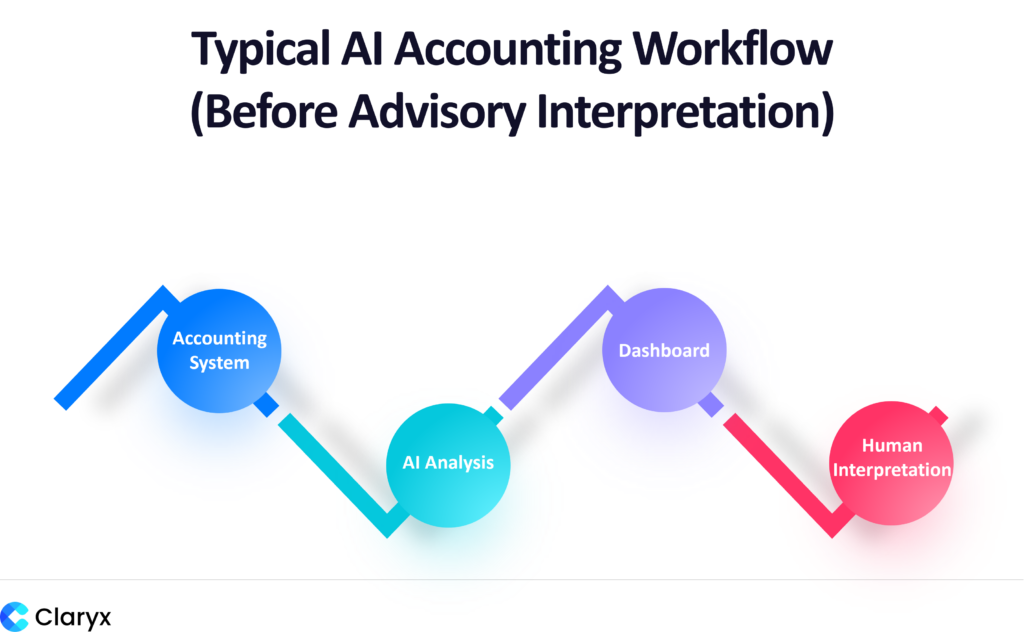
    Typical AI Accounting Workflow (Before Claryx.ai Advisory Interpretation)” showing a linear process from Accounting System to AI Analysis to Dashboard, ending with Human Interpretation, illustrating how financial data flows through AI tools before requiring human judgment.
    Diagram titled “Typical AI Accounting Workflow (Before Advisory Interpretation)” illustrating a linear process where data flows from an Accounting System to AI Analysis, then to a dashboard, and finally requires human interpretation. The image shows how advisory insight depends on manual interpretation without a structured advisory layer.

    Accounting system → AI analysis → Claryx.ai advisory layer → Decision-ready insight

    This matters because firms that adopt AI without advisory structure risk becoming:

    • Commoditized compliance providers
    • Lower-margin service businesses
    • Reactive instead of proactive

    Firms that pair AI with Claryx.ai convert automation into advisory capacity.

    AI for Accounting Will Not Replace Accountants, the Data Confirms It

    Despite rapid AI adoption, there is no evidence of accountant displacement at scale.

    Instead, data shows:

    • Rising demand for advisory services
    • Increasing expectations for interpretation and explanation
    • A growing skills shift toward communication and analytical judgment

    At the same time, AI investment reached $109.1 billion in 2024, reinforcing that automation will only accelerate (Stanford, 2025).

    This combination creates a clear outcome:

    Accountants who rely on automation alone risk commoditization. Accountants who control interpretation increase relevance.

    Claryx.ai is built for the second group.

    Preparing for 2026: What AI for Accounting Adoption Data Is Really Saying

    The statistics point to one conclusion:

    • AI adoption is inevitable
    • Automation is baseline
    • Advisory execution is the differentiator

    By 2026, successful firms will not be defined by whether they use AI for accounting but by how well they convert AI output into confident decisions.

    That requires:

    • Automation for speed
    • AI for detection
    • Structured systems for interpretation
    • Humans for accountability

    Claryx.ai connects those layers.

    Conclusion: AI for Accounting Needs More Than Algorithms

    AI has already transformed accounting operations. What it has not solved is advisory delivery at scale.

    Claryx.ai exists because statistics alone don’t create understanding and AI alone doesn’t create trust.

    By structuring AI-driven accounting insights into prioritised, explainable, and actionable guidance, Claryx.ai turns automation into something clients actually value: clarity and confidence.

    AI processes the data, Claryx.ai makes it usable.

    If you want to test what happens when AI accounting automation is paired with structured interpretation, start a Claryx.ai trial.

    See how faster reporting becomes clearer advisory conversations without replacing professional judgment.

    Sources

    Accounting sector profits surge with AI adoption, unlocking £1.6bn boost for UK economy. (2025). Xero. https://www.xero.com/sg/media-releases/uk-accounting-sector-profits-surge-with-ai-adoption/

    McKinsey & Company. (2025, March 12). The state of AI: How organizations are rewiring to capture value. McKinsey & Company. https://www.mckinsey.com/capabilities/quantumblack/our-insights/the-state-of-ai

    Stanford University. (2025). The 2025 AI Index Report. Stanford.edu. https://hai.stanford.edu/ai-index/2025-ai-index-report
  • The Silent Revolution: How AI Accounting Automation is Rewiring Finance in 2026

    The Silent Revolution: How AI Accounting Automation is Rewiring Finance in 2026

    In a modest business park on the outskirts of Singapore, a month-end close that once consumed fourteen working days now completes in three. No overtime. No weekend sprints. Just an AI agent quietly reconciling intercompany transactions across fifteen currencies while the finance team focuses on what the numbers actually mean. 

    This isn’t a preview of the future. It’s happening now. 

    What we’re witnessing in accounting automation qualifies as a fundamental restructuring of how financial work is performed, how firms are valued, and who captures the economic surplus. 

    For those with an understanding of the underlying dynamics, the investment case has rarely been clearer. 

    The Shift Few Saw Coming

    The narrative around automation has been predictable: eliminate data entry, speed up the close. Important, but tactical. What’s unfolding in 2026 represents something more profound. 

    The industry is moving from passive tools toward “agentic” AI that executes entire workflows—audits, month-end closes, collections cycles—with minimal human intervention. In 2025, 95% of accountants adopted automation to streamline processes such as payroll and accounts payable, but the real story lies beneath that headline. Nearly half of all accountants now use AI every day, and what they’re using it for has changed fundamentally. 

    The tools are no longer passive assistants. They’re autonomous agents that perceive, reason, act, and review—planning multi-step workflows and self-correcting when exceptions arise. 

    Adoption rates in Europe jumped from 8% to 42% in a single year, and by 2026, 80% of large companies will have their own AI systems to support financial decisions. This isn’t gradual diffusion. It’s a phase transition. 

    A New Valuation Logic For Accounting Software

    Markets are beginning to price this shift with startling clarity. The AI accounting software market is expected to grow from $6.68 billion in 2025 to $37.6 billion by 2030—a compound annual growth rate of 41%.

    But the more revealing signal comes from M&A markets. “AI-native” firms like Claryx.ai are commanding increasingly higher multiples, with private equity investors pushing valuations significantly higher for firms demonstrating strong recurring revenue streams and technology adoption.

    The traditional valuation model—revenue multiples tied to headcount and billable hours—is giving way to something new: AI leverage ratios. Investors are asking a different question now. Not “How many accountants do you employ?” but “How much revenue can each accountant generate when supported by autonomous systems?”

    A recent fundraise offers a case study. Maxima, an AI accounting platform automating month-end closes, raised $41 million in combined seed and Series A funding at a $143 million post-money valuation. The company barely existed eighteen months ago. What investors are buying is the embedded option on a world where financial close cycles shrink from weeks to days, and labor costs decouple from transaction volume.

    What’s Actually Working in Accounting Automation

    There is no doubt that in a rapidly evolving environment such as AI software, it is understandable that accounting professionals are sceptical of vendor claims.

    Early adopters of agentic AI in finance have slashed close times by up to half, with AI agents accelerating processes by a third or more by reconciling accounts, flagging errors, and spotting unusual transactions. AI agents are learning from historical remittance patterns to match payments faster (up to 90% automation) and more accurately (as high as 99%), according to vendor data.

    These aren’t laboratory conditions. Accountants using AI support more clients per week and finalize monthly statements 7.5 days faster than those using traditional methods. Cumulatively, this unlocks nearly seven weeks of productive capacity per employee each year—time now being redirected from compliance to counsel.

    The cash impact is tangible. Around 80 per cent of accountants anticipate growth in strategic advisory services within the next year, with the volume expected to rise by an average of nearly 40%.

    The 95/5 rule

    The firms succeeding in 2026 will be those that have adopted what we call the 95/5 rule: the AI agent handles 95% of transactions along the “happy path,” while flagging the 5% of ambiguous, high-risk, or high-value items for human review, with process owners establishing early human-in-the-loop checks to provide context and prevent risk. 

    The competitive advantage lies not in having the most sophisticated AI, but in trusting it enough to let it act—and building the governance frameworks to audit its decisions after the fact. 

    What About the Accounting AI Trust Barrier?  

    For all the momentum, a critical obstacle persists: trust. Trust in agentic AI to support finance workflows emerged as the leading barrier to tool use at over 21%, with nearly 60% of respondents in a Deloitte survey saying they trust AI agents to make decisions only within a defined framework. 

    This is not irrational technophobia. These systems are non-deterministic. They can hallucinate. They require governance. 

    Perhaps counterintuitively, the biggest technical obstacle isn’t the AI itself. Accountants report managing an ever-increasing array of digital tools, and nearly all of the firms believe better integration is key to unlocking their full potential. Many firm leaders also report that their AI initiatives are stalled because data is fragmented across disconnected systems.

    This is the unglamorous truth: Before buying more tools, you need to fix your data architecture. Standardize charts of accounts. Build APIs between core systems. Create a single source of truth. The ROI on data hygiene now exceeds the ROI on new software licenses.

    What Past Technology Disruptions in Accounting Reveal About 2026

    Every major technological shift in finance—from spreadsheets to ERPs to cloud accounting—followed the same pattern. Early adopters gained an initial competitive advantage. Then the technology democratized, and the advantage shifted to those with superior execution rather than superior access.

    We are still in the early-adopter window for agentic AI. But it’s closing. Gartner predicts 90% of finance teams will use at least one AI-powered solution by 2026. By 2028, this will be table stakes.

    The firms that will lead—and the investments that will compound—are those solving for the hard problems after adoption: governance, integration, talent, and trust. The technology is no longer the bottleneck. Organizational readiness is.

    For investors and operators alike, 2026 is not the year to wait for clarity. It’s the year to position for what’s already inevitable.

    Three Key Trends To Watch in Accounting Automation

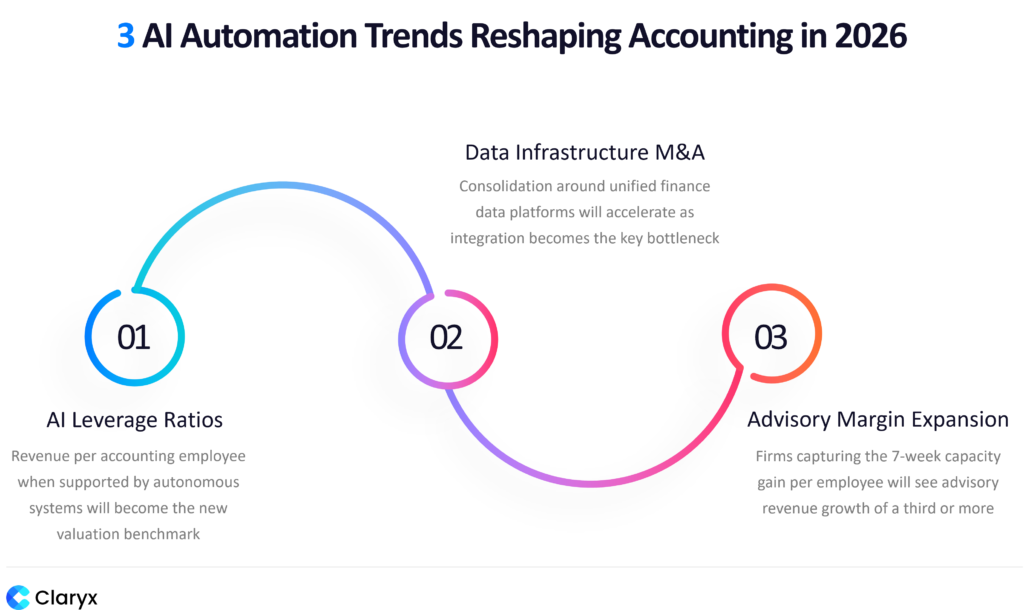
    Infographic titled “3 AI Automation Trends Reshaping Accounting in 2026” showing a connected three-step timeline: (1) AI leverage ratios, where revenue per accounting employee increases through autonomous systems; (2) data infrastructure M&A, highlighting consolidation around unified finance data platforms; and (3) advisory margin expansion, where firms convert AI-driven capacity gains into higher advisory revenue.
    1. AI Leverage Ratios – Revenue per accounting employee when supported by autonomous systems will become the new valuation benchmark. 
    1. Data Infrastructure M&A – Consolidation around unified finance data platforms will accelerate as integration becomes the key bottleneck. 
    1. Advisory Margin Expansion – Firms capturing the 7-week capacity gain per employee will see advisory revenue growth of a third or more. 

    Claryx.ai AI — The Opportunity For the Accounting Firms 

    For Claryx.ai, this moment represents more than market validation—it represents a structural advantage. 

    The data is clear: an overwhelming majority of firms demand better integration, yet a full 70% remain stalled by fragmented systems.Claryx.ai solves this precisely: a unified intelligence layer that transforms financial data into actionable insights. While competitors chase features and the Big Four deploy hundreds of agents, Claryx.ai occupies different ground—the connective tissue between systems and decisions. 

    If you want to test what happens when AI accounting automation is paired with structured interpretation, start a Claryx.ai trial.

    See how faster reporting becomes clearer advisory conversations without replacing professional judgment.

    Sources

    The statistics and insights in this article are drawn from leading industry research and professional services publications, including the 2025 Intuit QuickBooks Accountant Technology Survey, Wolters Kluwer Future Ready Accountant Report, PwC AI Agent Survey, Gartner research on AI amongst others. All data represents publicly available information.