AI for accounting practices has passed the experiment stage, it is operational.
By 2025, 88% of organizations report regular AI usage in at least one business function (McKinsey, 2025). In the UK alone, 98% of accounting practices already use AI in daily workflows, reporting average time savings of nearly 19 hours per week (Sach, 2025).
On paper, this looks like success.
However, in practice many firms still struggle to translate those gains into better advice, stronger client relationships, or higher-value services.
This gap explains why AI adoption has not automatically produced advisory transformation and why AI for accounting now needs a second layer: structured interpretation.
That layer is where Claryx.ai operates.
What “AI for Accounting” Actually Means Today
In simpler terms, AI for accounting refers to capabilities embedded across modern AI accounting software and cloud accounting applications, including:
- Automated transaction classification and reconciliation
- Continuous variance and anomaly detection
- Pattern recognition across large financial datasets
- AI-assisted summaries and forecasts
These tools are effective at speed and scale.
However, research shows that most firms apply AI in isolated workflows rather than end-to-end decision processes. Adoption is wide, but maturity is uneven.
In other words:
Firms have AI but not a system for turning AI output into consistent insight.
The Productivity Paradox in AI for Accounting: Why Advisory Still Bottlenecks
Firms using AI report completing tasks in 31% less time on average, primarily through accounting automation applications that reduce manual effort (Xero, 2025).
Yet those gains often stall at reporting.
Why?
Because AI produces:
- More alerts
- More dashboards
- More summaries
But not more clarity.
This creates a paradox where accountants spend less time preparing data but more time deciding:
- Which insights matter
- How to explain them
- Whether they justify client action
Without structure, AI for accounting increases signal volume without improving decision quality.
Why AI Accounting Software Statistics Don’t Create Advisory Insight
AI excels at identifying what changed. It struggles with why it matters.
This is not a technology failure it’s a category misunderstanding.
According to industry research, AI systems:
- Cannot determine materiality without business context
- Cannot judge which anomalies are decision-relevant
- Cannot own accountability for recommendations
This is why professional judgment remains central to accounting, even as automation accelerates.
AI supports accountants, it does not replace their reasoning.
The Missing Advisory Layer in AI for Accounting Software
Most AI accounting software stops at analysis. Claryx.ai starts where most tools stop.
Claryx.ai is designed as an advisory layer that sits between AI output and human judgment, structuring financial intelligence so it becomes:
- Prioritised
- Explainable
- Action-oriented
- Client-ready
Instead of asking accountants to interpret dozens of AI signals manually, Claryx.ai applies advisory logic that mirrors how experienced professionals already think.
This directly addresses the gap highlighted by adoption statistics: AI is everywhere, but interpretation is not scalable.
From AI Accounting Automation to Advisory Enablement
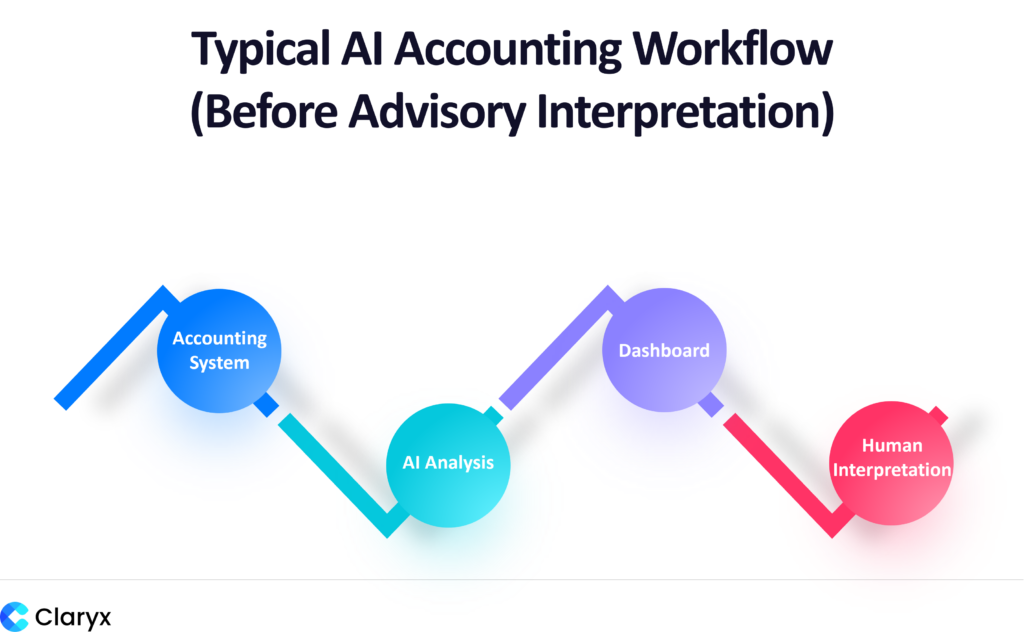
Most cloud accounting applications follow this workflow:
Accounting system → AI analysis → Dashboard → Human interpretation
Claryx.ai changes the architecture:

Accounting system → AI analysis → Claryx.ai advisory layer → Decision-ready insight
This matters because firms that adopt AI without advisory structure risk becoming:
- Commoditized compliance providers
- Lower-margin service businesses
- Reactive instead of proactive
Firms that pair AI with Claryx.ai convert automation into advisory capacity.
AI for Accounting Will Not Replace Accountants, the Data Confirms It
Despite rapid AI adoption, there is no evidence of accountant displacement at scale.
Instead, data shows:
- Rising demand for advisory services
- Increasing expectations for interpretation and explanation
- A growing skills shift toward communication and analytical judgment
At the same time, AI investment reached $109.1 billion in 2024, reinforcing that automation will only accelerate (Stanford, 2025).
This combination creates a clear outcome:
Accountants who rely on automation alone risk commoditization. Accountants who control interpretation increase relevance.
Claryx.ai is built for the second group.
Preparing for 2026: What AI for Accounting Adoption Data Is Really Saying
The statistics point to one conclusion:
- AI adoption is inevitable
- Automation is baseline
- Advisory execution is the differentiator
By 2026, successful firms will not be defined by whether they use AI for accounting but by how well they convert AI output into confident decisions.
That requires:
- Automation for speed
- AI for detection
- Structured systems for interpretation
- Humans for accountability
Claryx.ai connects those layers.
Conclusion: AI for Accounting Needs More Than Algorithms
AI has already transformed accounting operations. What it has not solved is advisory delivery at scale.
Claryx.ai exists because statistics alone don’t create understanding and AI alone doesn’t create trust.
By structuring AI-driven accounting insights into prioritised, explainable, and actionable guidance, Claryx.ai turns automation into something clients actually value: clarity and confidence.
AI processes the data, Claryx.ai makes it usable.
If you want to test what happens when AI accounting automation is paired with structured interpretation, start a Claryx.ai trial.
See how faster reporting becomes clearer advisory conversations without replacing professional judgment.
Sources
Accounting sector profits surge with AI adoption, unlocking £1.6bn boost for UK economy. (2025). Xero. https://www.xero.com/sg/media-releases/uk-accounting-sector-profits-surge-with-ai-adoption/
McKinsey & Company. (2025, March 12). The state of AI: How organizations are rewiring to capture value. McKinsey & Company. https://www.mckinsey.com/capabilities/quantumblack/our-insights/the-state-of-ai
Stanford University. (2025). The 2025 AI Index Report. Stanford.edu. https://hai.stanford.edu/ai-index/2025-ai-index-report
